

Quick Reference: Spray Foam R-Value by Thickness
|
Thickness |
Closed-Cell R-Value |
Open-Cell R-Value |
|
1 inch |
R-5.6 to R-8.0 |
R-3.6 |
|
2 inches |
R-11 to R-16 |
R-7.2 |
|
3 inches |
R-17 to R-24 |
R-10.8 |
|
4 inches |
R-22 to R-32 |
R-14.4 |
|
5.5 inches |
R-31 to R-44 |
R-19.8 |
|
6 inches |
R-34 to R-48 |
R-21.6 |
Note: Closed-cell R-value ranges from R-5.6 to R-8.0 per inch depending on density and formulation.
What Is R-Value and Why Does It Matter for Your Home?
R-value is a number that depicts the thermal resistance of an insulating material. It is a measure of how well an insulating material resists heat transfer. Thermal insulation is essential in homes to create comfort, prevent heat loss, and lower energy bills. The higher the number, the better the material’s ability to prevent heat transfer through conduction.
Spray foam insulation R-value represents the heat resistance for every inch of insulation applied. In essence, a recommended thickness of R-30 is achieved by applying a 5.5-inch depth of spray foam with an R6 rating.
Spray Foam R-Value Per Inch: Complete Breakdown
Closed-Cell Spray Foam R-Value Per Inch
Closed-cell spray foam provides R-5.6 to R-8.0 per inch depending on density and formulation:
- Medium-density (2 lb/ft³): R-5.6 to R-6.0 per inch
- High-density (3 lb/ft³): R-7.0 to R-8.0 per inch
Most residential applications use medium-density closed-cell foam with R-6.0 per inch as the standard.
Open-Cell Spray Foam R-Value Per Inch
Open-cell spray foam consistently delivers R-3.6 per inch regardless of thickness. This is approximately half the thermal resistance of closed-cell foam.
Open Cell vs. Closed Cell: Which Type of Spray Foam Offers Better R-Value?
Closed-cell and open-cell spray foam have different thermal resistance capabilities because of their unique structure. Generally, closed-cell spray foam offers a better R-value. Closed-cell spray is composed of completely closed cells that are tightly packed. Due to its cell structure, it is highly dense and offers higher thickness than open-cell foam. The closed-cell spray foam r-value is between R5.6 to R8.
In comparison, open-cell spray foam is composed of loosely packed cells. They are less dense and lighter than closed-cell foam insulation. The open-cell spray foam's R-value is R3.6 per inch thick.
Understanding the open-cell vs closed-cell debate is crucial to choosing the right spray foam. For better air barrier and moisture resistance, closed-cell spray foam is preferred over open-cell. Closed-cell spray foam offers better structural properties such as R-value and density. Thus, they are ideal for insulating cold climates and areas prone to flooding.
What Factors Affect the R-Value of Spray Foam Insulation?
3 major factors affect the spray foam insulation R-value. They include density, thickness, and type of spray foam insulation. These factors also affect the overall effectiveness of spray foam insulation.

How Does the Material Composition Impact the R-value of Spray Foam Insulation?
The two main chemical components of Spray Polyurethane Foam are polyol resins and isocyanate. These chemicals are mixed in the right proportion to produce an effective spray foam product. The ratio and quality of these chemicals can impact insulation properties. Therefore, if the formulation favors the production of closed-cell structures more than open-cell structures, then a high R-value product is created and vice versa.
A typical scenario of how material composition impacts R-value is the formulation of closed-cell spray foam. The production of spray foam insulation thickness R-value as high as R5.6 to R7 involves adding blowing agents. Blowing agents are added in the formulation of closed-cell spray foam to create gas within the foam, leading to a rigid and dense structure.
Why Is the Density and Cell Structure of Spray Foam Critical for Its R-value?
Cell structure and density are essential factors that are critical to spray foam insulation's r-value. Cell structure determines the density and strength of spray foam. A tightly packed cell structure such as closed-cell spray foam reduces heat transfer significantly. The increased density due to the cell structure causes a higher R-value. On the other hand, loosely packed cells with tiny spaces, such as open-cell spray foam, are light and less dense.
Here is how spray foam's density and cell structure are critical to its R-value; a 2-inch closed-cell spray foam r-value is typically between R12 - R14 (within the full range of R11 - R16 depending on density). On the other hand, 2-inch open-cell spray foam offers an R-rating of R7. It is better to use closed-cell spray foam to achieve a high R-value insulation.
How Do Thickness and Application Technique Influence Spray Foam Insulation's R-value?
Spray foam insulation r-value is directly proportional to its thickness. The thicker the insulation, the higher the R-value. Typically, 3 inches of closed-cell spray foam provides a higher R-value than a 2-inch thickness.
Regarding the application technique, the R-value is directly proportional to the correct application. Application techniques influence spray foam insulation’s ability to resist heat transfer. Improper application of spray foam compromises the effectiveness of insulation. Spray patterns, layering methods, surface preparation, and environmental conditions at the time of application are some techniques that can reduce the effectiveness of spray foam insulation. That said, hiring a professional contractor ensures effective spray foam insulation installation.
Wall frame depth directly affects achievable R-value. For example, 2x4 walls with 3.5-inch cavities can accommodate R-19 to R-28 with closed-cell spray foam, while 2x6 walls with 5.5-inch cavities achieve R-31 to R-44. See our dedicated wall sections below for complete specifications.
How to Choose the Right R-Value for Your Insulation Project?
Choosing the right R-value for your insulation project is essential to ensure maximum energy efficiency and comfort at home. There are four (4) vital factors to consider when selecting the right R-value for your insulation. These factors include geographic location, building design, area of application, and local building codes. Here is how you can go about it:
1. Assess Your Geographic Location:
The location of your building will determine the amount of R-value needed to keep your space warm and comfortable. The location of your building in this context refers to the climate. According to the Department of Energy, different climate zones in the US have varying R-value requirements. Locate your climate zone using the map below.

Image sourced from the U.S. Department of Energy’s Energy Saver insulation guide.
2. Determine the Area of Application:
After finding your climate zone, the next step is to determine the part of your building to be insulated. Then check the minimum recommended R-value based using the spray foam insulation R-value chart.
Here is a table showing the recommended R-value for different parts of a building:
|
CLIMATE ZONES |
UNINSUL. ATTICS |
UNINSUL. FLOOR |
CRAWL SPACE |
BASEMENT WALL |
|
1 |
R30 - R49 |
R13 |
R13 |
R11 |
|
2 |
R49–R60 |
R13 |
R13 - R25 |
R11 |
|
3 |
R49–R60 |
R19 |
R13 - R25 |
R11 |
|
4 (except marine) |
R60 |
R19 |
R25 |
R11 - R25 |
|
4 marine & 5 |
R60 |
R30 |
R25 |
R11 - R25 |
|
6 |
R60 |
R30 |
R25 |
R25 |
|
7 & 8 |
R60 |
R38 |
R25 |
R25 |
3. Check Local Building Codes:
Local climate and environmental conditions are key factors that building codes take into account when specifying the recommended insulation requirements. Ensuring that the insulation project adheres to these building codes is essential for compliance.
4. Consider Building Design:
Wall thickness, ventilation, building orientation, and roof design are building designs that must be considered when choosing R-value. For instance, thick walls do not need as much insulation as thin walls. In addition, the type of material used in construction plays a role in determining the R-value needed for maximum comfort.
How Does Spray Foam Insulation's R-Value Improve Energy Efficiency?
Improving energy efficiency is one of the significant benefits of installing spray foam insulation. Spray foam insulation R-value is enough to reduce the workload on your HVAC system. Precisely, spray foam insulation reduces HVAC sizing by 35% while maintaining comfort and efficiency in your building.
Spray foam insulation creates an air seal in buildings, reducing air infiltration by sealing leaks. This results in a significant reduction in energy consumed by the HVAC system to keep the building cool.
What Are the Long-Term Savings Associated with High R-Value Insulation?
Installing high R-value insulation such as closed-cell spray foam means better thermal insulation. High R-value insulation reduces energy consumption in your home significantly, thereby saving money on energy bills. The money spent on installing the insulation is recovered in no distant time.
High R-value insulation improves the lifespan of your HVAC system. A properly insulated home puts less strain on the HVAC system. Insulation reduces the constant need to heat or cool. There is less need for regular repairs, thereby maintaining efficiency and improving lifespan.

Spray Foam R-Value for 2x4 and 2x6 Walls
2x4 Wall Spray Foam R-Value
A 2x4 wall has a 3.5-inch cavity depth:
- Closed-cell spray foam: R-19 to R-28 (3.5 inches × R-5.6 to R-8.0)
- Open-cell spray foam: R-12.6 (3.5 inches × R-3.6)
Most building codes require R-13 to R-20 for walls, making closed-cell the better choice for 2x4 framing in most climate zones.
2x6 Wall Spray Foam R-Value
A 2x6 wall has a 5.5-inch cavity depth:
- Closed-cell spray foam: R-31 to R-44 (5.5 inches × R-5.6 to R-8.0)
- Open-cell spray foam: R-19.8 (5.5 inches × R-3.6)
Technical Details: How R-Value Is Calculated
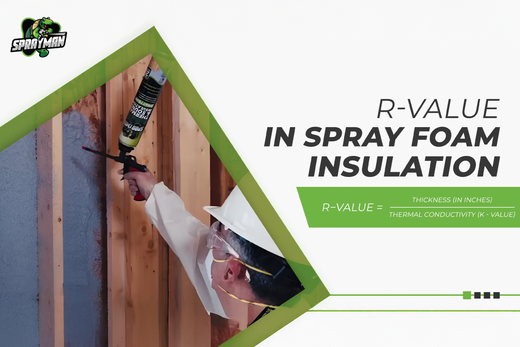
For readers interested in the underlying science, R-value is calculated as the ratio of insulation thickness to thermal conductivity:
Formula:
R-value = Thickness (in inches) / Thermal conductivity (k-value)
What is thermal conductivity (k-value)?
Thermal conductivity measures how easily heat conducts through a material. Lower k-values indicate better insulating properties.
Spray foam k-values:
- Closed-cell foam: k-value of 0.14 to 0.18
- Open-cell foam: k-value of 0.28 to 0.30
Closed-cell foam's lower k-value (approximately half that of open-cell) directly explains why it delivers roughly double the R-value per inch.
Example calculation:
A spray foam material with a k-value of 0.15 and applied thickness of 2 inches would have:
- R-value = 2 ÷ 0.15 = R-13.3
Practical note: Most homeowners and contractors use manufacturer-specified R-values per inch (R-5.6 to R-8.0 for closed-cell, R-3.6 for open-cell) rather than calculating from k-values. The quick reference charts and thickness recommendations provided earlier in this guide cover virtually all residential and commercial applications.
Ready to insulate your walls? Explore our Closed-Cell Spray Foam Kits available in coverage sizes perfect for 2x4 and 2x6 wall projects.
FAQs
Why Is R-Value Important When Calculating Spray Foam Insulation Costs?
R-value directly affects insulation performance and cost. Higher R-values require more material, increasing expenses. For a detailed cost analysis, visit our Spray Foam Insulation Cost Guide.
How many Inches of Spray Foam Insulation Do I Need?
The thickness depends mainly on the application area and the type of spray foam. To achieve maximum energy efficiency, you must determine the ideal spray foam insulation thickness based on your specific project goals and local building codes. Typically, 2–3 inches of closed-cell foam is required for walls, while 4–5 inches are applied on roofs. Open-cell spray foam requires greater depth, often ranging from 6–10 inches for roof decks.
What Are the Different Types of Spray Foam Insulation?
There are two distinct types of spray foam insulation; closed-cell and open-cell spray foam insulation. Learn more about the specific types of spray foam insulation, including open-cell and closed-cell options, in our detailed comparison guide on "Open Cell vs Closed Cell Spray Foam: Complete Comparison Guide"
Does Spray Foam Insulation Lose Its R-value?
Spray foam insulation R-value does not decline over time. When properly installed, spray foam is highly durable and can maintain its durability over a long period.
What Is the R-value of a 2x6 Wall with Spray Foam?
A 2x6 wall with spray foam achieves R-31 to R-44 with closed-cell foam (5.5 inches × R-5.6 to R-8.0 per inch) or R-19.8 with open-cell foam (5.5 inches × R-3.6 per inch). 2x6 wall frames are ideal for cold climates because they easily exceed code requirements with either foam type.
How Does the R-Value Relate To Soundproofing in Spray Foam Insulation?
High R-value insulation provides soundproofing capabilities by reducing sound transmission. The minimum R-value required in residential buildings for soundproofing is R13 - R19. In addition, open-cell spray foam offers inherent soundproofing abilities by absorbing sound waves.
Is There a Connection Between R-Value and Air Leakage in Insulation?
R-value has no significant connection with air leakage in insulation. A high R-value building can still experience poor energy efficiency when it is not properly air-sealed. To achieve optimal performance, both high R-value insulation and effective air sealing are necessary, but they address different aspects of a building's thermal envelope.



Leave a comment
This site is protected by hCaptcha and the hCaptcha Privacy Policy and Terms of Service apply.