
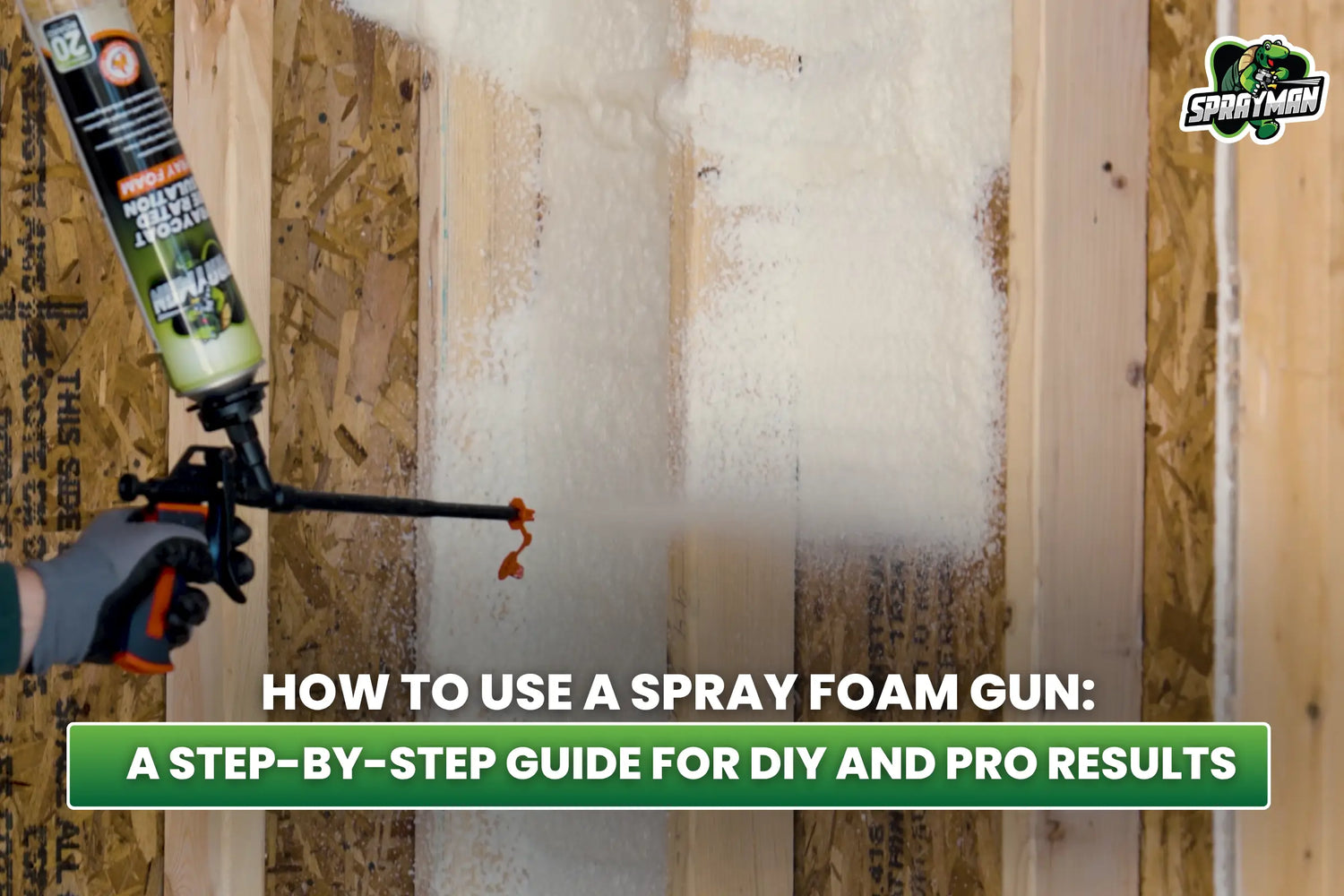
A spray foam gun connects to a pressurized polyurethane foam canister and delivers adjustable flow, precise placement, and on-demand start-stop control. Compared to a straw applicator, a foam spray gun reduces material waste, reaches deeper into cavities, and produces a consistent bead on every pass. Using one correctly means preparing the surface, shaking the canister, picking the right nozzle, holding the can upside down, and cleaning the tool with a spray foam gun cleaner before foam cures. Closed-cell gun-applied foam typically delivers between R-5 and R-7 per inch depending on the product, and coverage per can varies by formulation and application thickness.
This guide walks through every step so you get full coverage and a clean result on the first try. It also covers pest safe foam and fire block foam applications where a gun gives you control that a straw cannot match.

How to Use an Expanding Foam Gun in 7 Steps
Follow these 7 steps to use an expanding foam gun correctly from setup to cleanup.
- Clean the surface and mist it lightly with water
- Bring the canister to room temperature, then shake for 60 seconds
- Select the correct nozzle and attach it firmly to the gun
- Screw the canister onto the gun in one motion; hold it upside down
- Test-fire onto cardboard; adjust the flow control knob
- Apply in passes at 1/3 to 1/2 fill depth; mist between layers; wait for tack-free before the next pass
- Clean the gun with foam gun cleaner immediately after finishing
What Is a Spray Foam Gun?
A spray foam gun is a reusable applicator that threads onto a standard polyurethane foam canister and replaces the short plastic straw on single-use cans. It gives you 4 advantages a straw cannot provide:
- Adjustable flow rate for different gap sizes
- A rigid barrel for reaching deep into cavities
- A trigger that stops foam output instantly
- A sealed valve that helps keep the canister usable between short work sessions when stored according to the product instructions
A professional spray foam gun is worth using on any job involving more than 2 or 3 gaps. At that point, the control and reduced waste more than offset the cost of the tool. Contractors sealing rim joists, window rough openings, or crawl space walls routinely go through 12 to 24 cans per site visit. At that volume, a gun is the most practical option. Knowing which tools and safety gear to collect before opening the canister is the next step.
What Tools and Safety Gear Do You Need Before Starting?
The 7 tools and safety gear items you need before starting are:
- Foam insulation spray gun
- Compatible foam canister
- Replacement nozzles
- Spray foam gun cleaner
- Nitrile gloves
- Safety goggles
- Protective clothing

Collect everything before opening the canister. Uncured polyurethane foam bonds to skin within seconds. It also releases isocyanate vapor during application. Wear gloves and goggles before touching the canister. For indoor applications, use appropriate respiratory protection as recommended on the product label or safety data sheet, and ensure strong ventilation. Good surface protection now prevents cleanup problems later, marking the start of the next step.
The video below shows the full kit setup and application process from start to finish, a useful reference before your first use.
How Do You Prepare the Surface Before Spraying?
To prepare the surface before spraying, complete these 4 steps:
- Remove dust, grease, rust, and loose debris from the substrate
- Ensure the surface is dry and structurally sound
- Mist the surface lightly with water
- Mask adjacent surfaces with tape and plastic sheeting
A dirty or oily surface causes foam to peel away during curing instead of bonding to the material. Misting matters because polyurethane foam cures through a moisture-activated chemical reaction. A damp substrate gives the foam more to react with. This improves adhesion and shortens curing time between layers. This step matters most on porous materials like concrete, brick, and bare wood. Cured foam requires cutting or sanding for removal; solvent does not dissolve it. Protecting surfaces now saves time after the job. With the surface ready, the next step is setting up the canister and selecting the right nozzle.
How Do You Set Up the Canister and Gun?
To set up the canister and gun, complete 3 steps in order: temperature check, shaking, and nozzle selection.
- Temperature: Bring the canister to room temperature before use. Cold foam does not expand to full volume. Overheated foam discharges too fast and loses yield. Let the canister sit indoors for at least an hour if it has been in a cold vehicle or warehouse. Never warm it with direct heat.
- Shaking: Shake the canister vigorously for 60 seconds. Polyurethane components separate during storage. Skipping this step produces inconsistent foam density, poor expansion, and reduced coverage per can.
- Nozzle selection: Some gun-applied polyurethane foam canisters include different nozzle options for vertical and overhead applications. One is for vertical surfaces such as walls, stud bays, and rim joists. The other is for horizontal overhead surfaces such as ceilings and attic decks. Some guns also accept a wide spray foam gun nozzle for covering large open surfaces like roof decking or open wall bays in a single pass. Check your canister's label for the correct nozzle assignment. Push the nozzle straight onto the gun tip with firm, even pressure until it seats fully. A loose nozzle leaks foam around the collar instead of through the tip. With the nozzle locked in place, the canister is ready to attach.
How Do You Attach the Canister and Test the Gun?
To attach the canister and test the gun, follow these steps:
Attach the canister:
- Screw the canister onto the gun's basket in one committed motion. Going slowly lets propellant escape at the collar before the seal seats.
- Hold the canister with the valve pointing downward. Keep it in this position throughout the entire application. Working with the valve facing up reduces foam output and wastes yield.
Test before spraying:
- Fire a 1-second burst onto a piece of cardboard.
- The bead should be smooth, continuous, and consistent in diameter.
- Spitting or uneven output means the canister needs more shaking or the nozzle is not fully seated.
Set the flow control:
- Locate the flow control knob at the rear of the gun.
- Clockwise reduces output; counterclockwise increases it.
- Start at a lower setting. Overfilling a gap on the first pass causes foam to expand outward and distort door frames, window casings, or adjacent trim.

With the gun tested and flow set, you are ready to apply foam evenly along the surface.
How Do You Apply Foam Evenly Along a Gap or Surface?
To apply foam evenly, follow these guidelines:
Nozzle distance:
- For open vertical surfaces or spray-pattern nozzles, hold the nozzle about 12 to 18 inches (30 to 46 cm) from the surface. For narrow gaps and bead application, work closer with a lower flow setting and follow the canister or nozzle instructions.
- Ceiling and overhead surfaces: work closer at 6 to 8 inches (15 to 20 cm). A shorter distance counteracts gravity pull on the bead before it tacks.
Application direction:
- For vertical gaps, start at the bottom and move upward. This helps support the bead as it expands and reduces sagging before the foam sets.
Fill depth:
- Fill each gap or cavity to 1/3 to 1/2 of its depth on the first pass. Polyurethane foam expands significantly as it cures.
- Do not overfill. Outward bowing pushes window and door frames inward, preventing them from opening.
Trigger control:
- Maintain steady trigger pressure throughout each pass. Releasing and re-engaging the trigger too often creates uneven beads, small voids, or weak spots that reduce air-sealing consistency.
Between passes:
- Lightly mist the applied foam with water after each pass. Moisture activates the cure reaction on the surface and shortens the time before the next layer can go on.

Building thickness in controlled layers is the next step.
How Do You Build Thickness in Multiple Layers?
To build thickness, apply foam in multiple controlled layers rather than one thick pass. The number of layers depends on the product’s recommended lift thickness, curing time, and target insulation depth.
Layer targets:
- Target thickness for effective thermal insulation: 2 inches (5 cm)
- Typical layer approach: 2 or more controlled passes, depending on the product’s recommended lift thickness and target insulation depth.
- Single thick passes cure unevenly, develop surface cracks, and produce a lower actual R-value than the same spray foam insulation thickness built up in controlled layers.
How to check tack-free between layers:
- Wait until the surface is tack-free, typically 5 to 15 minutes depending on ambient temperature and humidity. This is the wait time for the applied surface, not to be confused with the nozzle dry-out window, which is much shorter.
- Press a gloved fingertip lightly to the surface
- The layer is not ready if foam transfers to the glove
- The next layer can go on if the surface holds its shape without sticking
R-value by product:
- Closed-cell spray foam typically adds approximately R-5 to R-7 per inch, depending on the product
- Check your canister's technical data sheet for the rated R-value of the specific formulation you are using
Avoiding nozzle dry-out:
- Do not pause mid-canister for more than 5 minutes. This window applies to the nozzle, not the applied surface.
- Foam begins drying inside the nozzle during idle periods, independent of how long the surface takes to reach tack-free.
- Wipe the nozzle tip immediately with foam gun cleaner if a pause is necessary.
Once the target thickness is reached, the next phase is trimming, protecting, and cleaning up.
What Affects Long-Term Spray Foam Gun Performance?
Long-term spray foam gun performance depends on 3 factors beyond application technique: cleaning frequency, storage conditions, and temperature management. Each one directly affects how the gun performs on the next job. Neglecting any one of them shortens barrel life, wastes foam through inconsistent output, and eventually forces a replacement. Trimming and protecting the cured foam correctly is the first of these post-application steps.
How Do You Trim and Protect the Cured Foam?
To trim cured foam, wait until it reaches the cutting window. Most aerosol polyurethane foam products reach trim-ready in 30 to 60 minutes after application; check your canister's technical data sheet for the exact window. Use a utility knife or handsaw. Score lightly along the surface first. Make multiple shallow passes instead of a single deep cut. Trim flush with the surrounding material. Sanding with 80-grit sandpaper improves paint adhesion on the trimmed surface. After trimming, protect the exposed foam from UV exposure immediately. Cured polyurethane discolors within days in direct sunlight and degrades if left uncoated. Apply plaster, paint, or a UV-protective coating over all exposed foam. For outdoor applications, coating is not optional; it is required for long-term performance. Cleaning the gun immediately after the job protects the tool for the next use.
How Do You Clean an Expanding Foam Gun?
To clean an expanding foam gun, follow these 5 steps immediately after finishing the job:
- Remove the foam canister from the gun
- Dispense remaining foam onto scrap cardboard to clear the nozzle
- Attach a spray foam gun cleaner canister to the gun
- Pull the trigger and flush until the output runs completely clear
- Wipe the external nozzle tip, collar, and basket with a solvent-soaked cloth

The entire process usually takes only a few minutes. Do not skip it. Polyurethane foam begins curing inside the nozzle and barrel within minutes of the last trigger pull, especially in warm or humid conditions. Once cured inside the gun, solvent cannot dissolve it. Mechanical removal may damage the internal gasket and flow-control needle. A blocked gun requires full disassembly or replacement. The nozzle itself requires separate attention after each session.
The video below shows the cleaning process in real time, useful if you want to see the steps before doing it for the first time.
How Do You Clean an Expanding Foam Nozzle?
To clean an expanding foam nozzle, remove it from the gun and soak the tip in foam cleaner for 5 to 10 minutes. Then clear the opening with a thin wire or a burst of compressed air before reattaching. Most nozzles are designed for single use. Immediate cleaning after each session may allow 2 to 3 uses per nozzle. Replace the nozzle if foam has fully cured inside the opening. Forcing foam through a partially blocked nozzle tears the bead and creates voids in the applied layer. Proper storage after cleaning extends both gun and canister life between jobs.
How Do You Store the Gun and Canisters Between Jobs?
To store the gun between jobs, tighten the flow-control knob fully and leave a canister threaded onto the barrel. The canister's propellant pressure helps keep the barrel sealed and slows residual resin from curing on the internal components. Store canisters upright in a cool, dry location within the temperature range stated on the label. Keep them away from direct sunlight and all ignition sources. Never pierce or burn the pressurized container, even after use. A cold canister loses yield and increases cure time. Warm a cold can in room-temperature water before the next job, never with direct heat.
Should You Use a Spray Foam Gun for Pest Control Applications?
You should use a spray foam gun for pest control applications when filling gaps larger than 1/4 inch (6 mm). Aerosol straw cans lack the precision to pack material deep into rodent entry points. A gun lets you inject foam 6 to 12 inches (150 to 300 mm) into a wall cavity. This helps block deeper entry paths rather than sealing only the surface opening. For pest-related sealing, use a pest safe foam product specifically labeled for pest-blocking or pest-exclusion applications. Standard insulation foam can help close visible gaps, but it should not be used as a substitute for a dedicated pest-control program. Apply in 2 passes at 1/3 to 1/2 fill each to avoid expansion pressure that could crack surrounding drywall or masonry.
Can You Use a Spray Foam Gun for Fire Block Applications?
You can use a spray foam gun for fire block applications where building code requires a tested, fire-rated foam product. Fire block foam is specifically formulated to resist flame spread and slow fire penetration through gaps in walls, floors, and ceilings. A gun gives precise control over fill depth in wall penetrations, floor-to-ceiling assemblies, and around electrical conduit runs. Not all spray foams carry a fire-rated certification, and not all fire block products are intumescent. Verify the product's fire rating documentation before specifying it for a fire-rated assembly. Apply fire block foam to 1/3 to 1/2 of the gap depth and allow it to self-expand before trimming flush. Retain the product label or safety data sheet for building inspection documentation.
Common Spray Foam Gun Mistakes to Avoid
Most application failures come from 5 repeatable mistakes. Each one wastes material, reduces performance, or damages the gun.
-
Mistake 1: Not shaking the canister long enough.
Polyurethane components separate in storage. A poorly mixed canister produces a stringy, uneven bead with reduced expansion and weaker air-sealing performance. Shake for a full 60 seconds every time, even if the can was shaken recently. Thirty seconds is not enough for a full canister stored in cold conditions. -
Mistake 2: Holding the nozzle too close for the application type.
Holding the nozzle too close during wide-spray surface application can pile foam in one spot before it spreads evenly. For open vertical surfaces, stay in the 12 to 18 inch (30 to 46 cm) range when the product instructions call for that distance. For narrow gaps, use a lower flow setting and follow the nozzle guidance on the canister. -
Mistake 3: Overfilling the gap on the first pass.
Polyurethane foam expands significantly as it cures. A single full-depth pass pushes foam out of the gap entirely and bonds it to adjacent surfaces. Fill to 1/3 to 1/2 of the gap depth only. Add a second pass only if the first layer has not fully closed the gap after expansion. -
Mistake 4: Applying foam outside the working temperature range.
Polyurethane foam requires ambient and surface temperature above 41°F (5°C) during and after application. Below this threshold, the moisture-cure reaction slows, expansion decreases, and adhesion to the substrate weakens. Above 86°F (30°C), foam sets before it fully expands. In hot conditions, work in the early morning. In cold conditions, warm the canister indoors before use and never apply foam to frost-covered surfaces. -
Mistake 5: Skipping the gun cleaning step.
Foam residue can harden quickly inside the gun if cleaning is delayed. Once cured, solvent cannot remove it. Mechanical removal may damage the internal gasket and needle. Clean the gun immediately after every use. The process takes only a few minutes and helps prevent permanent blockage.
Curing Timeline Reference
The curing timeline for aerosol polyurethane foam follows 4 stages. Times vary by product, temperature, and humidity. Always check the technical data sheet for your specific canister.
|
Stage |
Typical Time |
Action |
|
Surface dry (tack-free) |
5 to 15 min |
Leave untouched; mist before next layer |
|
Trim ready |
30 to 60 minutes |
Cut excess with utility knife |
|
Paint ready |
8 to 12 hours |
Apply coatings |
|
Full cure |
24 hours |
Structural stability achieved |
Conclusion
Using a spray foam gun correctly comes down to preparation, technique, and cleanup. Surface prep, canister temperature, nozzle selection, fill depth, and gun cleaning all directly affect the quality of the finished job. Follow the steps in this guide and the instructions on your canister's technical data sheet, and the results will be consistent across every application.
For the spray foam gun, nozzles, extension tips, and foam gun cleaner, browse the complete guns, accessories, and tools collection.
Frequently Asked Questions About Spray Foam Guns
How far should a spray foam gun be held from the surface?
For open vertical surfaces or spray-pattern nozzles, hold the gun about 12 to 18 inches (30 to 46 cm) from the surface. For narrow gaps and bead application, work closer with a lower flow setting and follow the canister or nozzle instructions. For ceiling applications, 6 to 8 inches (15 to 20 cm) may provide better control.
Can a spray foam gun fill small cracks and gaps?
Yes. Use a narrow extension tip with the flow control set to low. This delivers a precise, thin bead into cracks as narrow as 1/4 inch (6 mm). A straw applicator or standard caulk is a better fit for gaps smaller than this.
How long does spray foam take to cure?
Surface dry (tack-free) takes 5 to 15 minutes. Trim-ready is reached at 30 to 60 minutes. Paint-ready is 8 to 12 hours. Full cure takes 24 hours. These windows vary by product, temperature, and humidity. Always check your canister's technical data sheet.
What happens if you do not clean a spray foam gun?
Uncleaned foam can harden inside the nozzle, barrel, and valve. Once cured, standard foam cleaner cannot dissolve it. The gun may require disassembly and could become difficult or impossible to reuse.
Are spray foam gun nozzles reusable?
Most nozzles are designed for single use. Cleaning the nozzle immediately after each session in foam cleaner may allow 2 to 3 uses. Replace the nozzle if cured foam has hardened inside the tip opening.
Can you use any foam canister with a spray foam gun?
Most professional spray foam guns accept standard screw-on canister collars. Check that the thread size on your canister matches the gun's basket before purchasing. Some brands use proprietary fittings that only work with their own canisters.
What is the difference between open-cell and closed-cell foam for gun use?
Closed-cell foam expands less, cures denser, and delivers higher R-value per inch. It suits exterior walls, rim joists, and moisture-exposed assemblies. Open-cell foam expands more aggressively, costs less, and suits interior partition walls and sound dampening. Choosing between open-cell and closed-cell spray foam comes down to the assembly type, moisture exposure, and target R-value for the specific area you are insulating. Most gun-applied insulation products sold in individual canisters are closed-cell. Confirm the foam type and rated R-value on the canister label before purchasing.

Leave a comment
This site is protected by hCaptcha and the hCaptcha Privacy Policy and Terms of Service apply.