
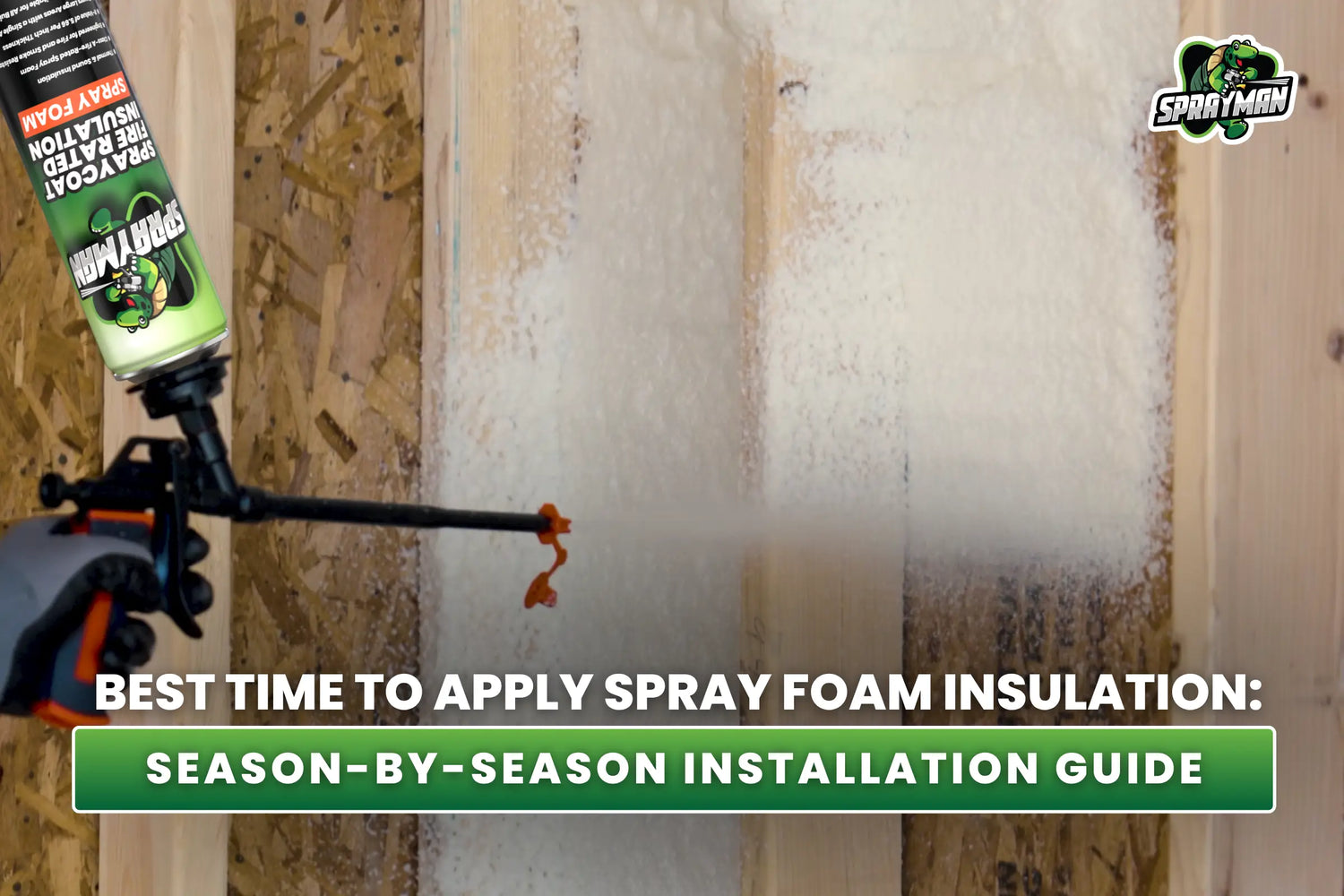
The best time to apply spray foam insulation is spring or early fall, when air and surface temperatures are more likely to stay within the 41°F to 86°F (5°C to 30°C) application range. Cold weather spray foam application is possible at the lower end of this range with proper can conditioning. Both summer and winter require extra preparation to keep conditions within the spray foam temperature limits. This window also brings lower humidity and drier surfaces, which support proper adhesion and curing. Spray foam temperature control starts with the can: optimal temperature is around 68°F (20°C), and a can that is too cold or too hot may reduce yield, slow curing, or affect finished foam quality. Space heating and air conditioning account for approximately 52% of a typical US home's annual energy consumption, based on the 2020 Residential Energy Consumption Survey from the US Energy Information Administration.
This guide covers spray foam temperature range requirements, a season-by-season breakdown, and the conditions that support or disrupt proper curing and adhesion.

What Are the Spray Foam Temperature Limits for Proper Application?
The spray foam temperature limits for proper application are 41°F to 86°F (5°C to 30°C) for both ambient air and substrate surface. Most single-component, moisture-cure closed cell spray foam insulation products, including Sprayman Spraycoat, cure by reacting with ambient humidity rather than mixing two components. This means can temperature and surface condition are the 2 most critical variables in every application. Below the lower limit, curing slows, yield may decrease, and finished foam quality may be affected. Above 86°F (30°C) at the substrate surface, the reaction accelerates past the designed rate, working time shortens, and adhesion quality may decrease.
Spray foam temperature control also covers can storage. A can that is too cold or too hot should be brought to around 68°F (20°C) before use. Immersing it in warm or cool water, or leaving it at room temperature for at least 24 hours, helps restore it to the right starting point. A laser infrared thermometer confirms substrate temperature at multiple points before each session. These steps apply regardless of season or outdoor conditions.
The 41°F to 86°F (5°C to 30°C) spray foam insulation temperature range is wider than many homeowners expect. Spring, fall, and even mild winter days in conditioned spaces can all be viable application windows. Seasonal timing sets the starting conditions, but location and surface prep determine whether those conditions hold throughout the job.

What Is the Best Season to Apply Spray Foam Insulation?
The best season to apply spray foam insulation is spring (April through May) or early fall (September through October) across most US climate zones. These seasons tend to keep ambient temperatures within the 41°F to 86°F (5°C to 30°C) range without additional preparation. Humidity levels also tend to stay moderate, which supports the moisture-cure mechanism without saturating surfaces. The best season shifts by region: in cold-winter states such as Illinois, Minnesota, and Pennsylvania, spring and fall are the primary windows; in warm-climate states such as Florida, Texas, and Georgia, summer can work when surface temperatures stay within range and applications are scheduled for shaded conditions.
|
Season |
Typical Ambient Temp |
Key Risk |
Can Prep |
Suitability |
|
Spring |
55°F-75°F (13°C-24°C) |
Low |
Minimal |
Excellent |
|
Summer (Jun-Aug) |
75°F-95°F (24°C-35°C) |
Overheating, humidity |
Keep can shaded |
Good with precautions |
|
Fall |
50°F-75°F (10°C-24°C) |
Low |
Minimal |
Excellent |
|
Winter (Nov-Mar) |
20°F-55°F (-7°C-13°C) |
Cold substrate, cold can |
Warm can to 68°F (20°C) |
Feasible in conditioned spaces |

Is Spring the Best Time to Apply Spray Foam Insulation?
Spring is the most reliable season for spray foam insulation in most US regions. Ambient temperatures in the 55°F to 75°F (13°C to 24°C) range keep cans close to the optimal 68°F (20°C) without conditioning, and humidity stays moderate, which supports adhesion without oversaturating surfaces. Attic, crawl space, and basement projects installed in spring lock in an air seal before summer heat loads arrive. Air sealing and adding insulation in attics, floors over crawl spaces, and basement rim joists may reduce heating and cooling costs by an average of 15%, based on EPA ENERGY STAR energy modeling of typical US homes. Spring also tends to offer better scheduling availability than the pre-winter fall rush, and unhurried surface preparation in favorable temperatures directly improves application quality. Summer conditions, by contrast, introduce overheating and humidity risks that require more active management.
Can You Apply Spray Foam Insulation in Summer?
Summer requires more preparation than other seasons because high ambient temperatures push substrate surfaces toward and sometimes beyond the 86°F (30°C) upper limit of the spray foam temperature range. An unventilated attic can reach 130°F (54°C) in July even when outdoor air sits at 85°F (29°C). Surface temperature checks with a laser thermometer prevent out-of-range application in these locations. The 3 main adjustments for summer installation are: applying to shaded surfaces first, storing cans away from direct sunlight, and scheduling work before temperatures peak in the morning. In warm-climate states, summer applications require extra caution: direct sunlight, high attic temperatures, and regional humidity can all push surfaces outside the recommended range. Cured foam discolors when exposed to ultraviolet light, so protect it with paint, plaster, or a suitable coating after the foam has fully hardened. Fall conditions resolve most of these challenges without additional effort.
Why Is Fall an Effective Season for Spray Foam Installation?
Fall is the second-best season and is particularly effective for weatherproofing before heating season begins. September and October temperatures in the 55°F to 70°F (13°C to 21°C) range keep conditions stable with minimal preparation, and low dew point keeps substrate surfaces dry for direct application in most locations. Fall installation addresses 3 specific winter risks before temperatures drop: ice dams forming through uninsulated roof assemblies, cold air infiltration through rim joists and crawl spaces, and drafts through window and door framing gaps. Insulating in fall captures the full winter season of potential energy savings from the first cold month, rather than waiting until spring to address problems that have already driven up heating bills. The tack-free time of around 5 minutes and full cure time of 24 hours both proceed reliably in typical fall ambient conditions. Winter requires a different preparation approach entirely.
How Do You Apply Spray Foam Insulation in Winter?
Winter is the most demanding season, but cold weather spray foam application remains feasible in enclosed conditioned spaces. The minimum application temperature for most single-component spray foams is around 41°F (5°C), and basements, crawl spaces, and rim joists often maintain temperatures above this threshold even when outdoor temperatures fall well below freezing. The most important preparation step is warming the can to around 68°F (20°C) before use: a can stored overnight in an unheated garage may read below 41°F (5°C) even if the job site itself is warmer. There are 4 required steps for low temp spray foam application in winter:
- Confirm air and substrate temperature above 41°F (5°C) with a laser thermometer before starting
- Warm cans to around 68°F (20°C) through warm water immersion or indoor storage for 24 hours
- Shake the can well immediately before use and keep the valve pointing downward throughout
- Maintain air temperature above 41°F (5°C) for at least 24 hours after application to support full cure
Temperature dropping below 41°F (5°C) within 24 hours after application may affect seal quality and cell structure. Plan interior winter jobs with this curing window in mind. Surface preparation standards remain the same in winter as in any other season.
What Else Affects Spray Foam Application Beyond Season?
Seasonal timing sets the starting conditions, but 3 additional variables determine whether a project performs well across its service life: surface preparation quality, knowing the spray foam temperature limits that disqualify a job site, and choosing the right product for the application. Each of these shifts the viable window in ways that season alone does not predict.
Should You Apply Spray Foam Insulation in Rain or High Humidity?
You should not apply spray foam insulation over wet, frosty, dirty, greasy, or contaminated surfaces. The substrate should be sound, clean, and dry before application. Wet surfaces create a barrier that prevents the polyurethane from bonding and may cause delamination after cure. Allow wet surfaces to dry fully before application; in many cases, waiting at least 24 hours after rain is a safer starting point, but actual drying time depends on material, airflow, and temperature. Lightly misting a dry substrate with water before application is different from applying over rain-soaked surfaces: a light mist can support the moisture-cure reaction and may improve adhesion, while standing water or saturated surfaces block it. Crawl spaces and basement rim joists are especially prone to moisture retention after rain; the spray foam crawl space insulation guide covers surface preparation steps specific to these locations.
When Should You Not Apply Spray Foam Insulation?
There are conditions under which spray foam insulation should not be applied, regardless of season. Applying outside these boundaries risks wasted material, poor adhesion, and reduced insulation performance. Do not apply spray foam insulation when:
- Air or surface temperature is below 41°F (5°C) or above 86°F (30°C)
- The can is too cold or overheated and has not been conditioned to around 68°F (20°C)
- The surface is wet, frosty, dusty, greasy, rusty, or otherwise contaminated
- The space cannot be adequately ventilated during application and curing
- The cured foam will remain exposed to direct sunlight without paint or coating protection
- You cannot continue spraying steadily, because stopping for more than 5 minutes risks foam drying inside the applicator
These conditions apply year-round. A warm spring day does not compensate for a frost-covered substrate, and a conditioned basement in January can be a safer application environment than a sun-baked attic in July. Thickness also affects performance: the spray foam insulation R-value guide explains how applied depth translates to thermal resistance across different climate zones and locations.
Which Spray Foam Products Work Best in Each Season?
Closed cell spray foam insulation is the core product for all 4 seasons when air and surface temperatures stay within the 41°F to 86°F range. Sprayman Spraycoat delivers up to 20 board feet per can at 1-inch thickness under standard application conditions, making quantity planning straightforward before any seasonal project. Pest Safe Foam is most effective in spring and fall, coinciding with the 2 peak periods for rodent and insect entry as animals seek shelter from temperature extremes. Windows and Door Foam handles a wide temperature range for gap sealing and suits year-round use. Whatever the season, having the right foam product on hand before conditions change makes the difference between a completed project and a missed window; visit Sprayman to see the full lineup of spray foam and foam sealant products.
Sources:
- US Energy Information Administration. Use of Energy in Homes. Residential Energy Consumption Survey 2020.
https://www.eia.gov/energyexplained/use-of-energy/homes.php - US Environmental Protection Agency. Methodology for Estimated Energy Savings from Cost-Effective Air Sealing and Insulating. ENERGY STAR. https://www.energystar.gov/saveathome/seal_insulate/methodology


Leave a comment
This site is protected by hCaptcha and the hCaptcha Privacy Policy and Terms of Service apply.