
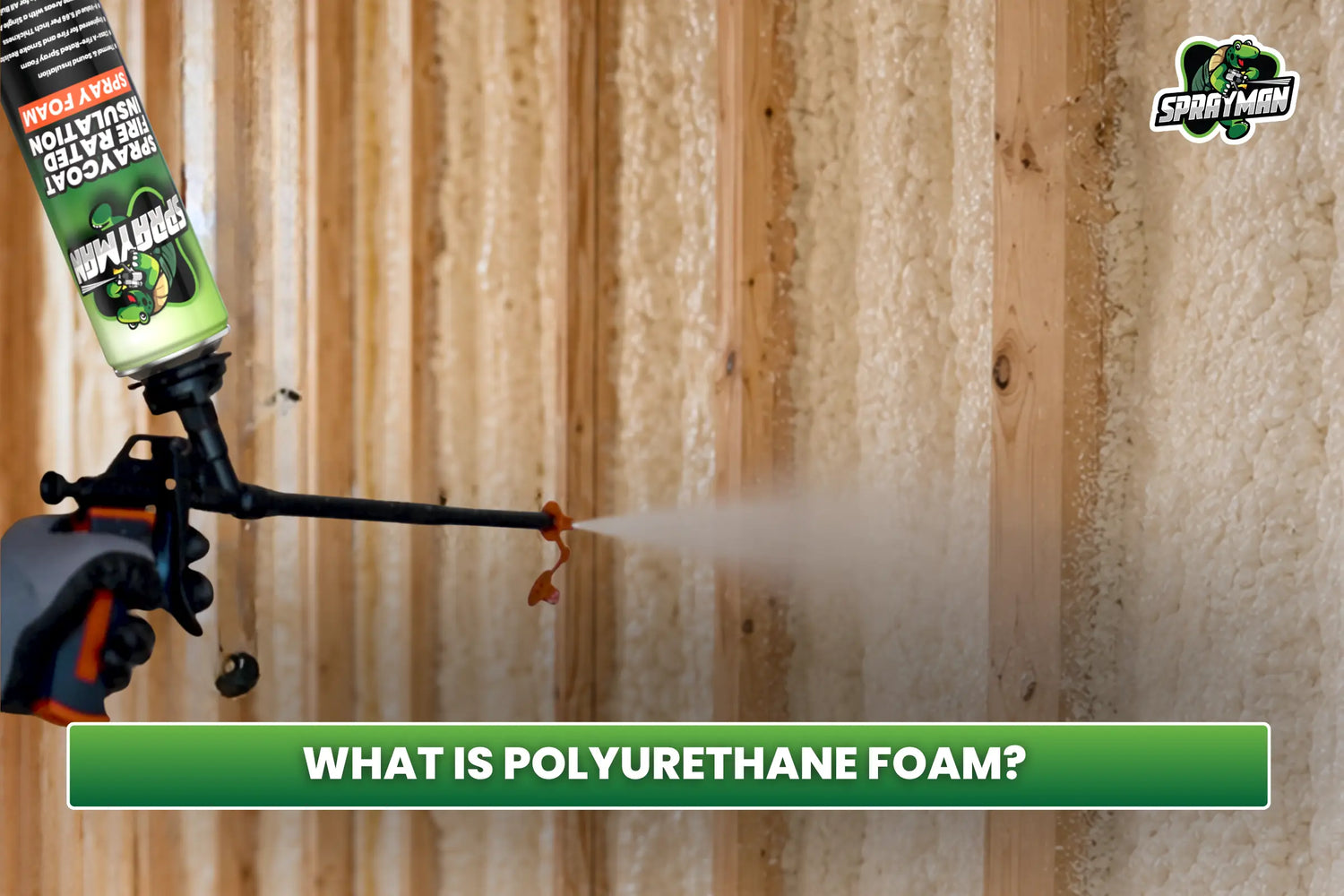
Polyurethane foam is a synthetic material formed when a polyol reacts with an isocyanate. The reaction creates a cellular structure that ranges from soft and flexible to dense and rigid, depending on the formulation, and PU foam is the short name many manufacturers and installers use for the same material family.
This guide covers what polyurethane foam is made of, how it is classified, and how spray foam insulation fits within that broader material family, along with safety considerations and how insulation-grade foam relates to foam sealant.

What Is Polyurethane Foam Made Of?
Polyurethane foam forms through a chemical reaction between two liquid components: a polyol and an isocyanate. This reaction forms the basis for the spray foam insulation used to air-seal homes. However manufacturers adjust the ratio of raw materials and additives to prioritize rigidity and thermal performance over cushioning.
Catalysts help control the reaction speed, while surfactants influence cell formation and stability. A blowing agent creates the gas bubbles that give the material its foam structure.
Depending on the formulation, the gas may come from a physical blowing agent that vaporizes as the mixture heats, or from a chemical reaction, such as water reacting with isocyanate to generate carbon dioxide. Spray polyurethane foam generally begins expanding and curing soon after application, but tack-free, trim, and full-cure times vary by product. The resulting density and firmness depend on this full combination of raw materials, additives, and processing conditions, which is why polyurethane foam is commonly grouped into three broad categories.
What Are the Main Types of Polyurethane Foam?
Polyurethane foam is commonly grouped into three broad categories: flexible, semi-rigid, and rigid. These products may also be described separately as open-cell or closed-cell, based on their internal cell structure. However the two classification systems overlap in most commercial products rather than matching exactly.
What Is Flexible Polyurethane Foam?
Flexible polyurethane foam compresses and springs back, and it typically has an open-cell structure. This foam appears in mattresses, upholstered furniture, automotive seating, and packaging cushioning, where comfort and shock absorption matter more than thermal performance. Rigid formulations trade this compressibility for structural stability.
What Is Rigid Polyurethane Foam?
Rigid polyurethane foam holds its shape under load, and it typically has a closed-cell structure. This type is built for structural and thermal applications, including insulation boards, refrigeration panels, and spray-applied home insulation.
What Is Semi-Rigid Polyurethane Foam?
Semi-rigid polyurethane foam offers more firmness than flexible foam while retaining some compressibility. Automotive interior padding and certain acoustic insulation products use semi-rigid formulations to balance cushioning with shape retention.
What Is the Difference Between Open-Cell and Closed-Cell Structure?
Open-cell foam has interconnected pockets that let air pass through, making it lighter and more flexible. Closed-cell foam has sealed, gas-filled pockets that significantly restrict air movement compared to open-cell foam, a distinction covered in more depth by a full comparison of open-cell and closed-cell spray foam.

What Is the Difference Between One-Component and Two-Component Polyurethane Foam?
One-component polyurethane foam is supplied as a ready-to-use single-component formulation that cures using moisture in the air, which makes it common for gaps, cracks, and controlled sealing jobs. Two-component foam mixes a polyol side and an isocyanate side at the point of application, allowing faster curing and larger application volumes. Both one-component and two-component polyurethane foam products can be used in home insulation, depending on the product design and project size: one-component products are commonly used for controlled applications and smaller insulation areas, while two-component systems are often selected for faster curing and larger-volume projects.
How Is Polyurethane Foam Used in Home Insulation?
Residential spray polyurethane foam insulation is available in both open-cell and closed-cell formulations, with closed-cell foam typically selected where a higher R-value per inch, greater rigidity, and lower water vapor permeance are priorities, such as basements, crawl spaces, and rim joists. Closed-cell spray polyurethane foam insulation commonly provides approximately R-5.5 to R-7 per inch. Exact R-value per inch varies by formulation, density, blowing agent, and test method, while the total installed R-value depends on the applied thickness, so the product's technical data sheet should confirm both figures. For example, Sprayman Spraycoat closed-cell insulation foam is rated at R-5.66 per inch, with one 27.1 oz can covering approximately 20 board feet at one-inch thickness, according to its technical data sheet. Higher R-values reduce heat transfer through a building's envelope, which affects heating and cooling costs, according to the U.S. Department of Energy.
What Are the Benefits of Polyurethane Foam Insulation?
Polyurethane foam insulation offers five practical advantages over traditional materials:
- Air Sealing: Expands into irregular gaps and cavities to create an air seal, while batt insulation generally requires separate air-sealing work around joints and penetrations.
- Low Moisture Retention: Closed-cell polyurethane foam has low water absorption and is less likely than fibrous insulation to retain moisture within its structure.
- Continuous Coverage: Expands across irregular surfaces and around penetrations, helping reduce gaps in the insulation layer.
- Long-Term Stability: Resists settling and compression and can maintain stable thermal performance for decades when properly installed.
- High R-Value per Inch: Closed-cell spray foam can provide substantial thermal resistance without requiring as much cavity depth as some lower-R-value insulation materials.
What Determines Whether Polyurethane Foam Is Safe to Use?
Properly applied polyurethane foam is generally considered stable after it has fully cured according to the manufacturer's instructions, though the application process itself requires care. During application, uncured ingredients and spray aerosols may irritate the skin, eyes, and respiratory system. Two-component spray foam applications in particular may require respiratory protection, protective clothing, gloves, eye protection, ventilation, and restricted access to the work area while curing. Ventilation and re-entry times vary by product, application method, and site conditions, so the product label, safety data sheet, and technical data sheet always take priority over general guidance on spray foam insulation safety. Fire behavior is one safety dimension that depends heavily on the specific formulation and any added fire retardants.
Is Polyurethane Foam Fire Resistant?
Polyurethane foam is fire resistant only to the degree that its specific formulation and any added fire retardants allow, since not all polyurethane foam meets fire-code requirements without modification. A Class A rating under ASTM E84 describes a material's surface-burning characteristics under a specific laboratory test; it does not mean the foam is noncombustible, and it does not mean the foam can always remain exposed. Depending on the location and the approved assembly, building codes may require a thermal barrier, ignition barrier, or another protective covering over the foam.
How Is Spray Polyurethane Foam Applied?
Spray polyurethane foam is applied differently depending on the product design and project scale. One-component foam may be dispensed through a straw or foam gun. Disposable two-component kits typically combine the chemical sides in a mixing nozzle, while professional systems meter and mix the components inside a specialized spray gun. Required canister, ambient, and substrate temperatures vary by product and application method, and applying foam outside the manufacturer's specified range can affect expansion, cell structure, adhesion, and curing.

How Is Polyurethane Foam Different from Foam Sealant?
Foam sealant is usually a type of polyurethane foam rather than a completely separate material. The practical difference is that insulation-grade spray foam is formulated and tested for larger-area thermal applications, while foam sealant is designed for controlled filling around gaps, joints, windows, doors, and penetrations, with different expansion rates, densities, and maximum recommended application thickness.
What Are Common Questions About Polyurethane Foam?
The following questions address points not fully covered above.
Is Polyurethane Foam the Same as Spray Foam?
Spray foam is one type of polyurethane foam, but not all polyurethane foam is spray foam. The broader polyurethane foam family also includes flexible cushioning foam, rigid insulation boards, packaging foam, automotive foam, and molded products. Spray polyurethane foam refers specifically to formulations applied as a liquid that expand and cure in place.
Does Polyurethane Foam Expand After It Cures?
No, polyurethane foam does not continue expanding after it cures. It expands only during the active curing phase, then stabilizes once fully cured. Trim time, the point after which foam can be safely cut or shaped, varies by product and ambient conditions and should be confirmed in the manufacturer's technical data sheet.
How Long Does Polyurethane Foam Last?
Properly installed closed-cell polyurethane foam can remain effective for several decades, since it does not settle or compress the way loose-fill materials do. Its actual service life depends on installation quality, UV exposure, moisture conditions, substrate movement, and physical damage, and any gradual thermal drift ties back to the R-value the foam was rated for at installation.
Can Polyurethane Foam Get Wet?
Closed-cell polyurethane foam typically absorbs relatively little liquid water compared with open-cell foam because of its predominantly closed-cell structure. It is water-resistant rather than automatically waterproof, and its vapor-retarding performance depends on the specific product and installed thickness. It should not replace a dedicated drainage or waterproofing system unless specifically approved for that purpose.
How Much Polyurethane Spray Foam Do I Need for a Project?
Coverage depends on the can's yield and the intended application thickness, not on square footage alone. As a general reference point, a single can that yields approximately 20 board feet covers about 20 square feet at one inch of thickness, or 10 square feet at two inches. Because most insulation projects call for more than one inch to reach a meaningful R-value, a coverage calculator that accounts for wall or attic dimensions and target thickness gives a more accurate can count than estimating by area alone.
Do Customers Notice a Learning Curve When Applying Polyurethane Spray Foam?
Some do, based on patterns across verified customer reviews. A recurring observation is that getting consistent thickness takes a few passes to dial in, since spray distance and nozzle angle affect how evenly the foam lays down, particularly on vertical or overhead surfaces. Reviewers who mention this learning curve also tend to report that results improve quickly once the technique feels familiar, and some separately note a temporary odor during application that fades as the foam cures. Reviewing the product's application instructions before starting, including recommended spray distance and layering guidance, can shorten this adjustment period.
What Is the Best Way to Get Started with Polyurethane Foam Insulation?
Getting started with polyurethane foam insulation means matching the right formulation, either open-cell or closed-cell, to the specific area being sealed, then confirming the product's technical data sheet before application. Homeowners exploring closed-cell spray foam insulation kits can review coverage, cure time, and safety requirements ahead of a first project.

Leave a comment
This site is protected by hCaptcha and the hCaptcha Privacy Policy and Terms of Service apply.