

Thermal bridging occurs when heat moves through a conductive building component, such as a wood stud, metal frame, rim joist, or window header, faster than it moves through the surrounding insulation. A wood stud carries a thermal resistance of about R-1.25 per inch, compared with roughly R-5.6 to R-7.0 per inch for closed-cell spray foam, so the gap in performance at these points is substantial. These weak points lower the effective R-value of a wall or ceiling, create cold interior surfaces, and raise the risk of condensation. Spray foam insulation helps reduce heat loss around thermal-bridge locations by sealing irregular gaps and, where the application extends across the framing, forming a more continuous insulation layer. Foam sprayed only between studs, however, does not fully stop heat flow through the framing itself, since the stud still touches both sides of the wall.

What Is Thermal Bridging?
Thermal bridging is heat transfer through a material that conducts heat faster than the insulation surrounding it. Wood studs carry a thermal resistance of about R-1.25 per inch, compared with R-3.3 per inch for fiberglass insulation, as reported in the U.S. Department of Housing and Urban Development's (HUD) published analysis of wood-framed construction, citing Bres (2009). Fiberglass batt products more broadly range from about R-2.9 to R-3.8 per inch depending on density and product type, so the HUD figure sits near the middle of that range rather than as a fixed industry constant. Because the stud is less resistant than the insulation next to it, heat crosses the wall faster at every stud than it does at the insulated cavity. Thermal bridging and cold bridging refer to the same phenomenon, with "cold bridging" more common in everyday and DIY use; and left unaddressed, this conductive heat loss creates a specific set of problems in a home.
Why Is Thermal Bridging a Problem?
Thermal bridging creates five practical issues in a home:
- Higher heating and cooling costs from heat bypassing the insulation layer
- Cold interior wall or ceiling surfaces near framing members
- A higher risk of surface condensation and mold growth when cold spots combine with elevated indoor humidity
- A lower effective R-value than the insulation's labeled rating
- Uneven room temperatures near exterior walls
Where Does Thermal Bridging Commonly Occur?
Thermal bridges typically form at six common points in a home:
- Wall studs and roof rafters
- Rim joists between the foundation and first floor
- Window and door headers
- Roof-to-wall junctions
- Garage-to-house shared walls
- Steel framing and structural fasteners
How Does Spray Foam Insulation Help Reduce Thermal Bridging?
Closed-cell spray foam reduces heat loss at thermal-bridge locations by combining insulation and air sealing in one application. Choosing the right spray foam insulation for the job matters as much as the technique used to apply it, since formulation and expansion rate both affect how completely a gap gets sealed. It expands around irregular framing, wiring, and penetrations where cut-and-fit batt insulation may leave voids if it is not installed precisely. The U.S. Department of Energy notes that closed-cell spray foam generally provides a greater R-value per inch than open-cell foam or standard fiberglass batt insulation. Closed-cell products commonly fall within an approximate R-5.6 to R-7.0 per inch range, though individual product values should be confirmed in the manufacturer's current technical data sheet. Its higher R-value improves the insulated portions of the assembly, while extending insulation across the framing itself is what reduces the conductive bridge.

|
Material |
Typical Approximate R-Value per Inch |
|
Wood stud framing |
About R-1.25 |
|
Fiberglass batt |
About R-2.9 to R-3.8 |
|
Closed-cell spray foam |
About R-5.6 to R-7.0 |
HUD's cited example uses approximately R-3.3 per inch for fiberglass. Actual values vary by product, density, formulation, and test method, and R-value alone does not determine whether a given thermal bridge has actually been interrupted.
What Is the Difference Between a Thermal Bridge and a Thermal Break?
A thermal bridge is the conductive path that lets heat bypass the surrounding insulation. A thermal break is the low-conductivity layer or component installed to interrupt that path. Spray foam applied between studs improves cavity insulation and air sealing, while insulation running continuously across the framing more directly interrupts heat flow through studs, joists, and metal members. The 2021 International Energy Conservation Code includes prescriptive wall assemblies that require or rely on continuous insulation in certain colder climate zones, depending on wall construction and the compliance path used, as discussed in HUD's analysis of the code update.
Where Can Spray Foam Help Reduce Thermal Bridging?
Spray foam performs best at points where framing creates gaps or irregular surfaces that are difficult to fit precisely with cut batt or rigid insulation. Three common areas for accessible DIY applications are rim joists, attic and roof junctions, and exterior wall framing.
Rim Joists
Rim joists often have irregular gaps and framing junctions where rigid or batt insulation may require careful cutting and separate air sealing. Spray foam can conform around the sill plate, band joist, and framing joints in a single application, making rim joists a practical starting point for accessible spray foam applications. Attics and roof junctions present a similar challenge in a different part of the house.
Attic and Roof Junctions
Top plates, roof-to-wall connections, and small hard-to-reach voids can benefit from foam's ability to expand into irregular spaces that are difficult to fit with rigid or batt insulation. Exterior wall framing is the largest and most repetitive version of this same problem.
Exterior Wall Framing
Wall studs are common repeating thermal bridges because they create a continuous conductive path through the insulated wall assembly, even when sheathing and finish layers are present on either side. Spray foam applied in open stud bays can improve cavity insulation and reduce air leakage more effectively than poorly fitted batt insulation. The choice between open-cell and closed-cell spray foam affects R-value, density, moisture behavior, and the required application thickness, but neither eliminates heat conduction through a stud when the insulation remains confined to the cavity. Fully reducing that conductive path requires insulation that extends continuously across the framing rather than filling it from within.

Garage-side framing may be accessible in unfinished spaces or during renovation work, making these shared walls a common example of this. For garage-to-house assemblies, preserve required fire separation and covering requirements and follow local code before applying any foam product, since these accessible points are also where most homeowners first work out how much material a project will need.
How Much Spray Foam Do You Need?
DIY spray foam coverage varies by formulation, density, application temperature, and technique. Always calculate material needs from the board-foot yield stated in the product's technical data sheet rather than a general assumption. For a canister rated in the 15-to-20 board-foot range, a 20-square-foot rim-joist area would require roughly one to two canisters at one inch thick, or about twice that at two inches thick, before allowing for overspray and surface irregularities.
How Does Thermal Bridging Relate to the Thermal Envelope and Thermal Barrier?
Thermal bridging connects directly to two other building-envelope terms worth understanding before starting a project.
Thermal Envelope
The thermal envelope is the complete boundary separating conditioned interior space from the outdoors, including every wall, roof, and floor assembly where a thermal bridge can form. Reducing thermal bridging at individual framing points is one part of strengthening the thermal envelope as a whole.
Thermal Barrier
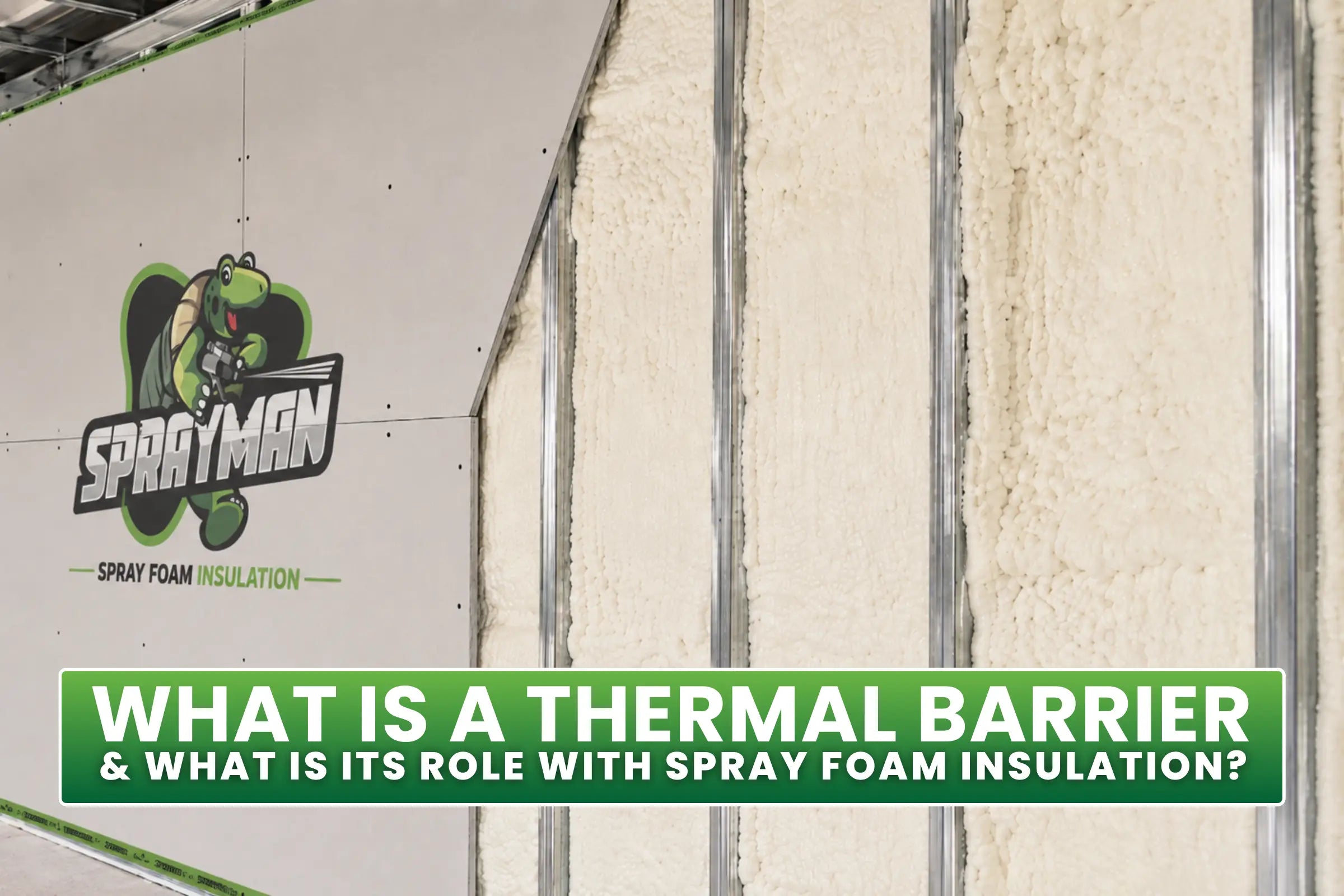
A thermal barrier is a different, code-specific term. In foam-insulation and building-code discussions, it usually means a protective layer, such as gypsum board, that separates foam plastic from the occupied space, rather than a layer intended to interrupt thermal conduction. This code-specific meaning becomes relevant in many spray foam applications because foam plastic may need to be separated from occupied space by an approved thermal barrier. Requirements vary by location, assembly, product approval, and local code; attics and crawl spaces may also involve separate ignition-barrier provisions.
Frequently Asked Questions
The following questions come up most often when homeowners research thermal bridging and spray foam.
Is Cold Bridging the Same as Thermal Bridging?
Yes, cold bridging and thermal bridging describe the same phenomenon, with "cold bridging" the more common term in residential and DIY contexts.
Does Spray Foam Completely Stop Thermal Bridging?
Not always. Foam sprayed only between studs leaves the stud itself as a conductive path. Thermal-bridge control improves when insulation extends continuously across the framing and reduces heat flow through the stud.
What Is the Best Insulation for Thermal Bridging?
Continuous insulation installed across framing is generally the most direct way to reduce thermal bridging. Spray foam can support that strategy by air-sealing irregular junctions where it extends across the conductive framing path. For a closer look at how formulation and thickness affect that performance, see our R-value in spray foam insulation guide.
Conclusion
Thermal bridging is common in wood-framed homes because studs, joists, and headers create conductive paths through insulated assemblies. Spray foam can improve insulation continuity and air-seal irregular framing junctions at rim joists, attic transitions, and accessible exterior wall cavities. However, insulation that extends continuously across the framing remains the more direct way to reduce the conductive bridge itself.
Review Spraycoat closed-cell spray foam coverage, R-value, application requirements, and available DIY kit sizes to determine whether it fits your rim-joist, attic, or garage-wall project.
Sources
- Kelley, Shawn P., and Mike Blanford. "Concept of Thermal Bridging in Wood-Framed Construction." Cityscape, Vol. 25, No. 1. U.S. Department of Housing and Urban Development. https://www.huduser.gov/portal/periodicals/cityscape/vol25num1/ch18.pdf
- U.S. Department of Energy, Office of Energy Efficiency & Renewable Energy. EnergySavers: Tips on Saving Money & Energy at Home. DOE/GO-102011-3291, December 2011. https://www.energy.gov/sites/prod/files/2013/06/f2/energy_savers.pdf
- 2021 International Energy Conservation Code (IECC), continuous insulation requirements for wood-framed walls

Leave a comment
This site is protected by hCaptcha and the hCaptcha Privacy Policy and Terms of Service apply.